Tech News /
Japan Wants to Build the World's Most Powerful Supercomputer: What Is Fugaku Next.
Fugaku Next: Japan's $750M Zettascale Supercomputer. From AI Performance to the Energy Bottleneck, the New Advanced Computing Clash Between the US and Asia.

Smart Shaped
Last update: September 2026
Fugaku Next (or FugakuNEXT) is Japan's project to build a next-generation supercomputer with "zettascale" ambitions, specifically targeting zettaFLOPS-class performance for Artificial Intelligence workloads. Coordinated by MEXT, RIKEN, and Fujitsu, the system aims to become operational around 2030 and surpass current exascale leaders.
The race to build the world's most powerful supercomputer is not merely a numbers game: it is a core benchmark of national capability across AI, complex simulation, and advanced scientific research. In this guide, you will find: key definitions (FLOPS, exascale, zettascale), direct comparisons with Frontier and Fugaku, projected costs and roadmap milestones through 2030, and an in-depth look at the often-overlooked challenges of energy, cooling, and sustainability.
What Fugaku Next is and why Japan aims for the world's most powerful supercomputer
Fugaku Next (FugakuNEXT) is Japan's flagship zettascale supercomputer initiative, designed to establish a global benchmark by around 2030 to power the future of AI and high-performance scientific computing. The program is led by MEXT (Ministry of Education, Culture, Sports, Science and Technology) alongside RIKEN (National Research and Development Institute) and Fujitsu as its primary industrial partner.

RIKEN defines the project's core mission as delivering the "world's first zetta-scale performance in AI (FP8)" and building a global ecosystem for system utilization and deployment (RIKEN Center for Computational Science: FugakuNEXT). In other words, the drive extends beyond raw rankings to training and deploying large-scale AI models alongside scientific simulations that are currently too slow or computationally cost-prohibitive.
These combined efforts aim to deliver a competitive system achieving the world's first zetta-scale performance in AI (FP8) and to build a global ecosystem through worldwide deployment.
— RIKEN Center for Computational Science, National Research and Development Institute
From a geopolitical perspective, zettascale High-Performance Computing (HPC) infrastructure is a cornerstone of technological sovereignty in global AI competition. For a broader view on this context, see the global AI race between the US, China, and Europe.
What zettaFLOPS means and how supercomputer performance is measured
A supercomputer is a specialized computing system designed to execute massive numbers of parallel operations to solve complex problems (such as AI, physics, climate modeling, and genomics) in fraction of the time required by standard systems. Performance is typically quantified in FLOPS (Floating Point Operations Per Second), the standard benchmark metric used across HPC rankings like the TOP500 list of the world's fastest supercomputers.

ExaFLOPS represents 10^18 operations per second, whereas zettaFLOPS represents 10^21 operations—a three-order-of-magnitude leap. While this jump does not automatically translate to a 1,000x real-world speedup for every application due to memory, interconnect, and software bottlenecks, it opens the door to handling models and simulations at scales previously considered impossible.
| Scale | Notation | Order of Magnitude | Typical Use Case |
|---|---|---|---|
| PetaFLOPS | PFLOPS | 10^15 | Advanced engineering simulations |
| ExaFLOPS | EFLOPS | 10^18 | Large-scale AI, climate modeling, astrophysics |
| ZettaFLOPS | ZFLOPS | 10^21 | Massive "AI-for-science", industrial digital twins |
To put the zetta scale into perspective, transitioning from 10^18 to 10^21 means multiplying theoretical compute capacity by 1,000. In practice, the engineering goal is to translate that theoretical leap into sustained application performance.
Fugaku Next vs. Frontier vs. Fugaku: comparing the supercomputers shaping the global race
Frontier serves as the current exascale benchmark in the United States, Fugaku represented Japanese HPC leadership up to 2022, and Fugaku Next targets a major generational leap engineered specifically for modern AI workloads. Comparing these platforms requires separating verified benchmark results from project design targets: for Fugaku Next, specifications reflect stated design goals rather than final production metrics.
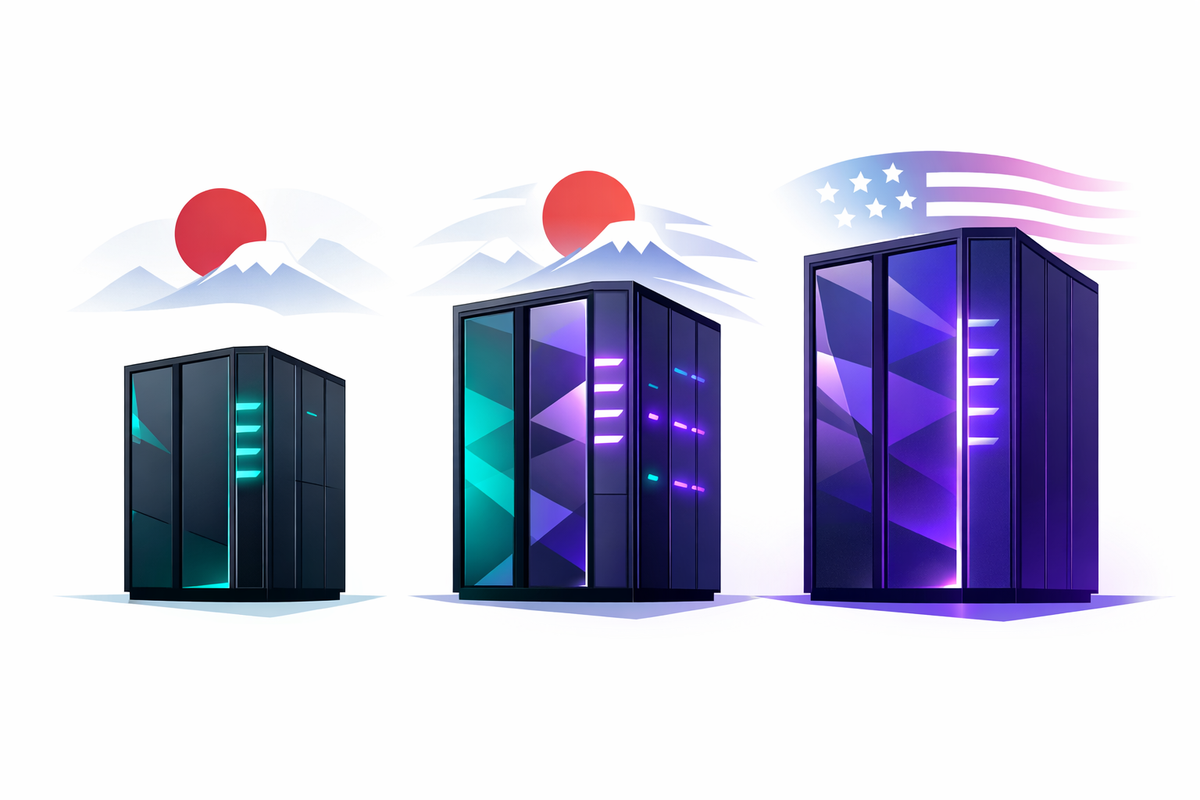
| System | Country | Institution / Facility | Performance Tier | Year | Primary Focus | Status |
|---|---|---|---|---|---|---|
| Frontier | USA | Oak Ridge National Laboratory (ORNL) | Exascale (measured) | 2022+ | Scientific HPC + AI | Operational |
| Fugaku | Japan | RIKEN Center for Computational Science (Kobe) | Exascale (peak ~0.44 EFLOPS) | 2020+ | Scientific HPC | Operational |
| Fugaku Next | Japan | RIKEN + Fujitsu + MEXT | "Zettascale" for AI (FP8 target) | ~2030 | AI-for-science + simulations | In Development |
Industry analysis indicates FugakuNEXT targets over 2.6 FP64 exaFLOPS (aggregate peak performance) and approximately 600 sparse FP8 exaFLOPS for AI—a figure framed as "zettascale" specifically for AI execution (Supercomputing.news, 2026: analysis). Crucially, "zettascale" in this context refers to reduced-precision AI math (FP8) rather than traditional double-precision FP64 scientific HPC calculations.
Understood in this light, the comparison reflects a country's ability to advance HPC and AI capabilities simultaneously through scalable system architectures and software ecosystems.
Who funds the project and key roadmap milestones through 2030
Fugaku Next is primarily funded by the Japanese government through MEXT, with RIKEN acting as the primary research authority and Fujitsu as the lead industrial manufacturing partner. Financial projections represent multi-phase budget allocations and overall estimations subject to adjustment during design and procurement phases.
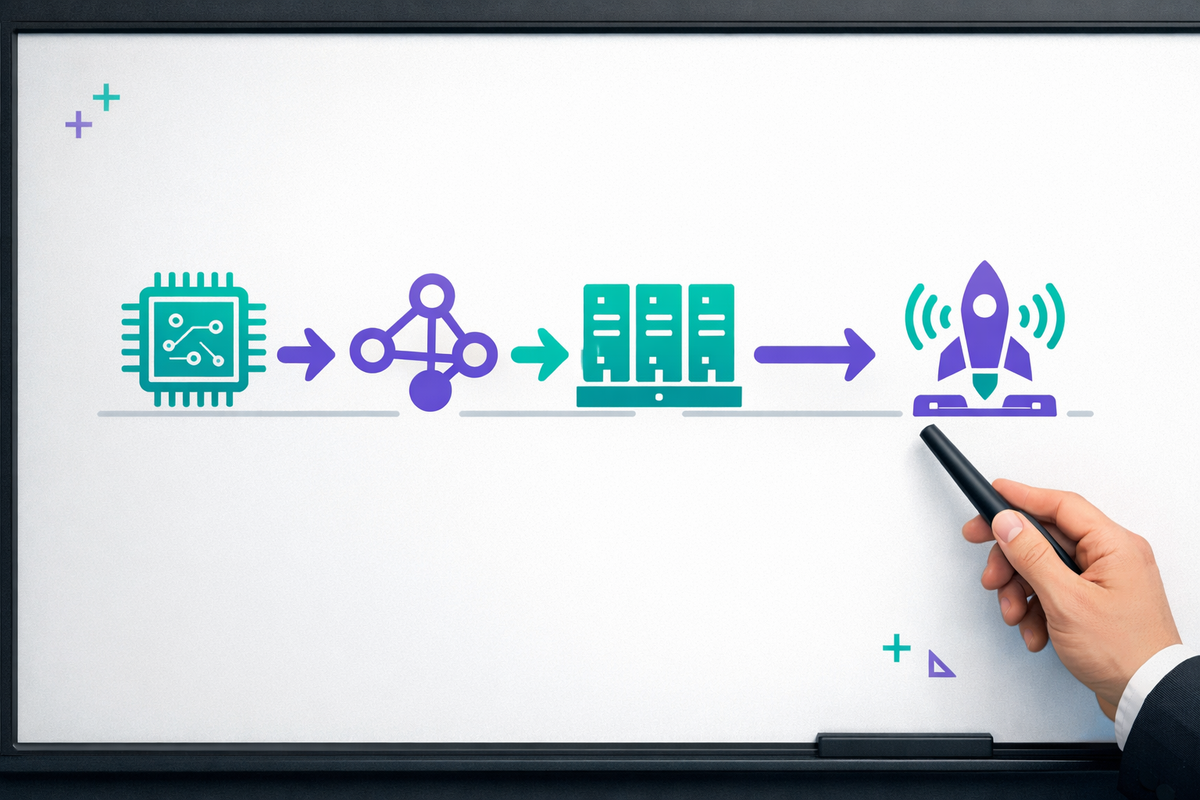
According to Supercomputing.news, MEXT approved approximately 4.2 billion yen for the initial development year, alongside an indicative total project budget around 110 billion yen (roughly $740–761 million USD, based on reported industry conversions) (Supercomputing.news, 2026: source). For comparable context on European infrastructure, read about Italian investments in supercomputers and AI Factories.
| Phase | Objective | Timeframe (Indicative) | Notes |
|---|---|---|---|
| Launch & Initial Funding | Requirement definitions and governance setup | 2025–2026 | Budgets and specifications evolving |
| Architectural Co-design | CPU/GPU, memory, fabric, and software design | 2026–2028 | Dual focus on AI + HPC workloads |
| Construction & Integration | System installation at RIKEN facility (Kobe) | 2028–2029 | Critical hardware logistics phase |
| Commissioning | System testing, application tuning, reliability checks | 2029–2030 | Planned overlap with original Fugaku |
| Full Operations | Deployment for scientific and industrial use | ~2030 | Stated target date by RIKEN |
Industry reports highlight a planned 2–3 year operational overlap between Fugaku and FugakuNEXT during commissioning to maintain scientific research continuity across national labs (Supercomputing.news, 2026).
Key technical hurdles in building a zettascale supercomputer
Constructing a zettascale supercomputer is not simply a matter of adding more silicon: scaling up requires breaking through architectural bottlenecks across memory bandwidth, system interconnects, fault tolerance, and software optimization. Fugaku Next addresses these challenges where traditional HPC and modern AI impose divergent requirements (FP64 precision vs. FP16/FP8 throughput vs. interconnect latency).

- Processors and Accelerators: heterogeneous architectures (CPU + GPU/NPU) enhance energy efficiency and AI execution. Official statements detail the RIKEN–Fujitsu–NVIDIA collaboration for Fugaku's successor (NVIDIA News, Nov 17, 2025: source).
- Memory and Bandwidth: compute power sits idle without sufficient memory throughput. High-Bandwidth Memory (HBM) and unified CPU-GPU memory coherence are central design priorities.
- High-Performance Fabric: low-latency, high-throughput interconnect networks are essential for distributing massive AI training runs and parallel simulations.
- Fault Tolerance: at zettascale, hardware failures and bit flips occur continuously, requiring advanced checkpointing and software resilience mechanisms.
- Real-World vs. Theoretical Performance: theoretical FLOPS peaks matter far less than sustained application performance across real-world scientific benchmarks.
Specialized architectural analyses—such as ARM/NPU integrations and memory coherence models detailed by ArmDevices (2025: deep dive)—illustrate the complex trade-offs involved in system design.
Energy, cooling, and sustainability: the true cost of zettascale power
The single greatest barrier to zettascale computing is energy consumption, not processing speed. The ultimate constraint is the sheer electrical power required to run the system and, crucially, the massive energy needed to dissipate heat continuously in an HPC data center environment.
HPC benchmarks like the Green500 index evaluate energy efficiency (performance per watt) alongside raw speed. In a zettascale environment, performance-per-watt efficiency determines whether a system is practically deployable or economically unfeasible.
System design strategies incorporate: (1) advanced liquid/immersion cooling techniques, (2) domain-specific AI accelerators optimized for reduced precision (FP8/FP16), (3) software optimization to minimize energy-intensive memory transfers, and (4) site-level power management infrastructure to guarantee operational stability. From a governance standpoint, organizations connect computing infrastructure to ESG frameworks; see tools for enterprise ESG implementation and using artificial intelligence to drive ESG sustainability.
Real-world applications of Fugaku Next: AI, climate, drug discovery, and industrial digital twins
Fugaku Next is engineered to solve complex scientific challenges rather than simply chase speed records, focusing on AI-for-science applications that currently require prohibitive compute times. RIKEN emphasizes zettascale AI capabilities (FP8) as a primary goal of the system architecture (RIKEN: overview).
- Generative AI & Frontier Models: expanded compute enables training and inference on massive foundation models using enriched datasets.
- Climate Modeling: high-resolution climate simulations leverage parallel compute capacity; for hybrid AI-physics approaches, see NeuralGCM for integrated weather forecasting.
- Drug Discovery: molecular dynamics, virtual screening, and molecular docking scale rapidly with increased compute capacity.
- Advanced Materials: quantum-level multi-scale simulations accelerate the discovery and synthesis of novel materials.
- Industrial Digital Twins: digital twin modeling for industrial facilities and supply chains requires robust HPC and data pipelines;
In the context of digital transformation, this infrastructure enables rapid R&D cycles and seamless integration across data pipelines, foundation models, and physical simulations. For enterprises, these capabilities connect directly to AI governance and risk management; in Europe, see the complete guide to AI governance and EU AI Act compliance.
Fugaku Next FAQ: zettaFLOPS, costs, and timeline
How much will Fugaku Next cost?
Industry reporting indicates an estimated total budget of approximately 110 billion yen (roughly $740–761 million USD), though final expenditures depend on hardware procurement and technical refinements. Initial funding allocations cover baseline research and preliminary development (2026).
Does zettaFLOPS mean 1,000 times faster than exascale?
ZettaFLOPS represents a 10^21 order of magnitude versus exascale's 10^18—a 1,000x increase in theoretical floating-point operations. However, real-world application speedups depend heavily on memory throughput, network latency, and software parallelization, yielding varying practical gains across workloads.
When is Fugaku Next scheduled to become operational?
The official project roadmap targets deployment around 2030 at the RIKEN facility in Kobe, Japan. Industry sources indicate a 2–3 year commissioning overlap with the original Fugaku system to preserve research continuity.
Is Fugaku Next competing directly for the top spot on the TOP500 list?
Not necessarily. System design prioritizes real-world application performance and AI execution (FP8 precision) over single FP64 benchmark scores. System value is measured by scientific output and industrial adoption rather than raw TOP500 ranking alone.
Which sectors stand to benefit most from zettascale supercomputing?
Domains requiring massive parallelism across AI and physical modeling benefit most: climate forecasting, drug discovery, materials science, and industrial digital twins. Academic researchers gain faster experimental throughput, while enterprises reduce R&D timelines through virtual prototyping.