Tech News /
China-Centric Silicon Independence: Alibaba Unveils Zhenwu V900 and New 10-Trillion-Parameter Roadmap
China-Centric Silicon Independence: Alibaba Unveils Zhenwu V900 and New 10-Trillion-Parameter Roadmap

Smart Shaped
At the Apsara Conference 2026, Alibaba unveiled the Zhenwu V900 AI accelerator (developed by T-Head) alongside a Qwen model roadmap targeting 5–10 trillion parameters. The most widely cited figures—216 GB of memory, 1,200 GB/s inter-chip bandwidth, and clusters of up to 500,000 cards—reflect press-reported statements: real-world competitiveness will depend on independent benchmarks, software stack maturity, and data center capacity (targeting 20 GW).

What did Alibaba announce at the Apsara Conference 2026?
Alibaba (the Chinese technology conglomerate) announced two core developments: the Zhenwu V900 AI chip from its semiconductor division, T-Head, and an ambitious roadmap for its Qwen family of LLMs targeting 5–10 trillion parameters. Eddie Wu (CEO of Alibaba Group) presented these releases as a full-stack strategy integrating semiconductors, cloud compute, networking, and foundation models, with commercial availability of the V900 slated for Q1 2027.

An important distinction must be made: while many specifications represent reported facts from media coverage of the event, performance claims (such as "most powerful in China" or "3x speedup over the M890") remain corporate claims pending standardized benchmarks. Reuters (September 22, 2026) reported cluster scalability reaching up to 500,000 chips and the 3x performance leap over the M890, attributing these figures directly to Wu.
Wu said the processor delivers three times the performance of its predecessor, the M890, and can be linked in clusters of up to 500,000 chips to train and run the largest AI models.
— Eddie Wu, Chief Executive Officer, Alibaba Group
Sources: Reuters (2026) and ABC News (2026).
- V900 Specs: 216 GB memory, 1,200 GB/s inter-chip bandwidth (Macau Business, 2026)
- Performance: “3x speedup vs. M890” (Alibaba claim via Reuters, 2026)
- Cluster Scale: up to 500,000 interconnected accelerators (Reuters, 2026)
- Go-to-Market: mass production and commercial release in Q1 2027 (ForkLog, 2026)
Which technical specifications make the Alibaba Zhenwu V900 significant?
The Zhenwu V900 (an accelerator designed for LLM training and inference) is significant because it attempts to deliver a complete "system platform" in China rather than just a standalone chip: compute, memory, and interconnect fabrics tailored for massive enterprise clusters on Alibaba Cloud. Industry coverage indicates the V900 integrates 216 GB of memory, inter-chip connectivity up to 1,200 GB/s, and native support for low-precision calculation formats such as FP8 and FP4 to maximize throughput and operational efficiency (Macau Business, 2026).
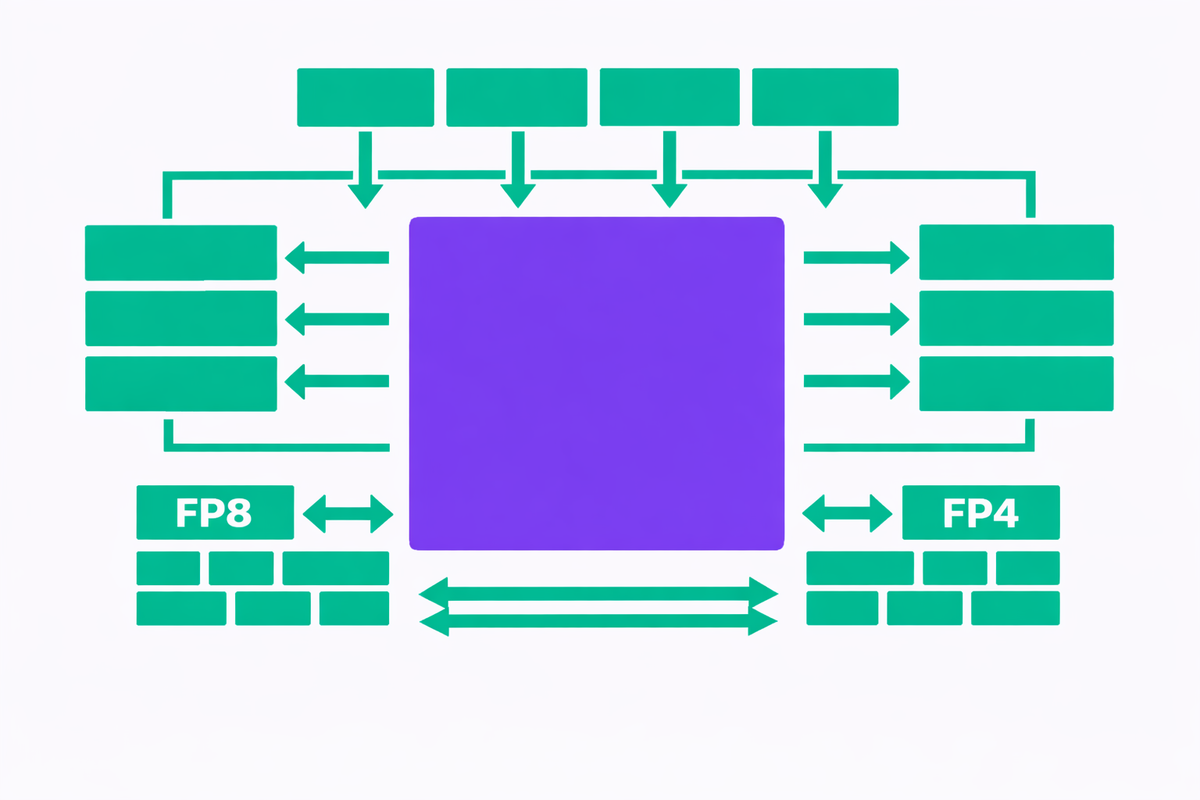
- 3x Performance Increase: Delivers three times the processing capability of the previous M890 generation (Alibaba claim reported by Reuters, 2026).
- Unprecedented Cluster Scalability: The architecture is designed to support super-clusters orchestrating up to 500,000 interconnected cards in parallel (Reuters, 2026).
- Mass Production Schedule: Volume manufacturing and commercial distribution are slated for Q1 2027 (ForkLog, 2026).
Memory capacity, calculation precision, and interconnect fabrics matter because they directly determine: (1) larger batch sizes and context lengths during training, (2) cost per token during inference, and (3) parallelization efficiency across nodes. However, the "3x vs. M890" figure remains unverified by independent benchmarks and does not replace standard evaluations like MLPerf.
How does the Zhenwu V900 compare to NVIDIA, Huawei, and previous Alibaba chips?
An accurate comparison must distinguish between disclosed specifications, non-public data points, and corporate claims. The table below uses only verified metrics reported by news outlets covering the Apsara Conference 2026 (Macau Business, Reuters, ForkLog), marking unverified attributes as "Undisclosed."
| Processor | Memory | Inter-chip Bandwidth | Precision | Gen-over-Gen Performance | Cluster Scale | Verification Status |
|---|---|---|---|---|---|---|
| Alibaba Zhenwu V900 | 216 GB (reported) | 1,200 GB/s (reported) | FP8/FP4 (reported) | “3x vs. M890” (claim) | Up to 500,000 (reported claim) | Partial (media reports, no public benchmarks) |
| Alibaba Zhenwu M890 | Undisclosed | Undisclosed | Undisclosed | — | Undisclosed | Limited (scarce public data) |
| NVIDIA H100 / Blackwell (B200) | Not in source set | Not in source set | Not in source set | — | Depends on NVLink / fabric | Not comparable here (lacks cited data in source set) |
| Huawei Ascend 910B/910C | Not in source set | Not in source set | Not in source set | — | Depends on fabric | Not comparable here (lacks cited data in source set) |
Where the V900 appears competitive is in its focus on high memory capacity (216 GB), interconnect bandwidth (1,200 GB/s), and extreme cluster scaling (up to 500,000 nodes). This addresses a clear objective: training and serving frontier models on Alibaba Cloud while bypassing network and compute availability bottlenecks frequently cited by Chinese teams (such as DeepSeek).
Where critical data remains missing includes manufacturing process nodes, thermal design power (TDP), advanced packaging/HBM supply, and software stack ecosystem maturity (the equivalent of NVIDIA's CUDA or Huawei's CANN). Without these variables, direct "vs. NVIDIA/Huawei" claims remain speculative. For broader context on NVIDIA's training supply, see NVIDIA and synthetic data innovation for AI training, and regarding Huawei, read Huawei's advanced AI models like Zhiji.
What does the Qwen 5–10 trillion parameter roadmap actually mean?
Targeting "5–10 trillion parameters" does not automatically guarantee a "5–10x jump in intelligence": execution efficiency depends on whether that figure represents total parameters, active parameters per token, or a Mixture-of-Experts (MoE) architecture routing requests across specialized sub-networks. Reuters (2026) reports that Qwen 4 is actively training, with subsequent iterations—Qwen 4.5 and Qwen 5—expected to reach the 5–10T parameter range. Highlights from the announcement also include Recursive Self-Improvement (RSI) techniques (where the system conducts experiments, generates synthetic data, and self-corrects errors). A practical example: a coding agent training micro-variants of its internal evaluator against real bugs, synthesizing tests, and selecting policies that minimize code regressions iteratively.
| Qwen Model | Status (Reported) | Scale Target | Public Timeline |
|---|---|---|---|
| Qwen3.8-Max | Released (reported) | 2.4T parameters (cited in context) | Unspecified |
| Qwen 4 | In training (Reuters, 2026) | Undisclosed | Undisclosed |
| Qwen 4.5 | Roadmap (Reuters, 2026) | Targeting 5–10T | Undisclosed |
| Qwen 5 | Roadmap (Reuters, 2026) | 5–10T target | Undisclosed |
The credibility of this model roadmap relies directly on underlying hardware infrastructure (V900 clusters), high-speed interconnects, and data center capacity: larger parameters and longer context windows require massive GPU memory capacity, ultra-fast east-west network bandwidth, and long-term operational cluster stability. For a comparison with other major LLM roadmaps, see LLM evolution and Amazon's AI roadmap.
Why 20 gigawatts of data center capacity is critical to Alibaba's AI strategy
A 20 GW data center target is critical because trillion-parameter AI execution is fundamentally an industrial challenge: power supply, liquid cooling, networking fabrics, and capital expenditure. "20 GW" measures installed power capacity (the electric load the facilities can continuously draw), not merely square footage. Scaling clusters to hundreds of thousands of accelerators (V900) makes power availability and Power Usage Effectiveness (PUE) hard operational constraints.
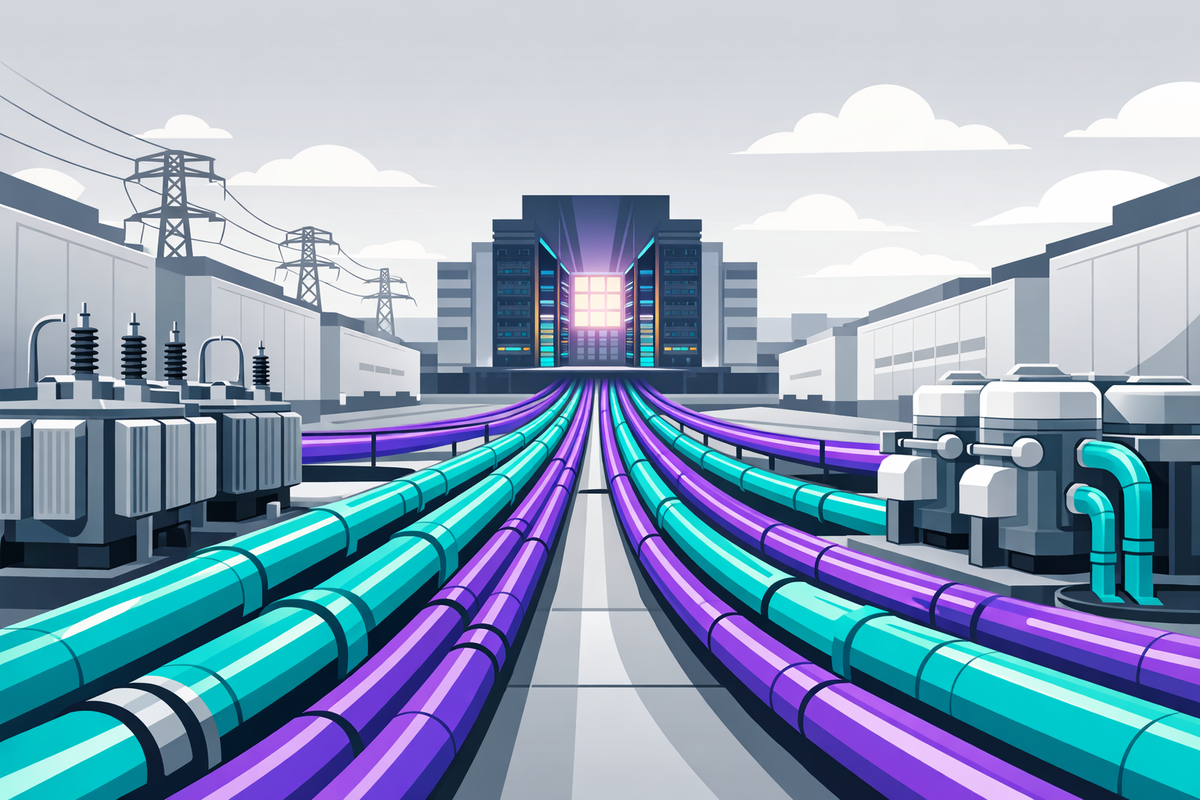
Operationally, data center economics revolve around rack density, liquid cooling adoption, network interface cards (NICs), and operational expenditure (OPEX) tied to power consumption. On the sustainability side, PUE metrics, renewable energy integration, water usage effectiveness, and carbon footprint tracking are central. For broader context on global compute infrastructure, see supercomputing infrastructure and global AI strategy, and regarding sustainability, consult tools for corporate ESG implementation and sustainability.
| Infrastructure Metric | Why It Matters | Implication for Qwen 5–10T |
|---|---|---|
| Power Capacity (GW) | Upper bound of deployable compute hardware | Determines maximum cluster scale and uptime |
| PUE | Ratio of non-IT overhead (cooling, power distribution) | Lowers cost per token and overall emissions |
| Rack Density | kW per rack and data hall spatial layout | Enables packing more accelerators per site |
| Liquid Cooling | Manages high thermal flux and power densities | Stabilizes extended training runs |
| Network Fabric | East-west bandwidth required for parallel training | Prevents communication bottlenecks in MoE/RSI models |
Which enterprise use cases can Alibaba's full-stack strategy enable?
Combining proprietary Zhenwu silicon, Qwen foundation models, and Alibaba Cloud infrastructure aims to reduce inference costs, foreign tech dependence, and deployment times for enterprise clients. For B2B buyers, evaluation metrics focus on price per token, latency, throughput, uptime reliability, and seamless integration with corporate governance structures.
- Banking Knowledge Assistants: Auditable Q&A engines querying internal policy docs, credit guidelines, and compliance workflows.
- Software Engineering Copilots: Refactoring, unit test generation, and automated code triage across enterprise repositories.
- Multilingual Customer Operations: Automated routing and response generation across digital customer channels backed by measurable SLAs.
- Document Automation Pipelines: Data extraction from contracts, legal filings, and financial statements with quality assurance loops.
- Academic & R&D Research: Deep analytics across scientific paper corpora and domain datasets with fine-grained access policies.
Alibaba's full-stack strategy addresses diverse enterprise scenarios, with a focus on regulated industries and secure data management. Deploying production AI requires MLOps pipelines, Data Governance, and statutory compliance: AI governance and EU AI Act compliance. Small and medium-sized enterprises can also leverage these architectures: AI adoption in SMEs and enterprise use cases.
How realistic is Alibaba's China-centric silicon independence?
China-centric silicon independence is a reality in terms of architecture design and full-stack integration (T-Head + Alibaba Cloud + Qwen), but does not equate to total supply chain self-sufficiency. Critical bottlenecks remain: advanced fabrication nodes (foundries like SMIC or TSMC), advanced packaging, HBM (High Bandwidth Memory) supply, photolithography equipment, and EDA (Electronic Design Automation) tools that remain linked to global ecosystems.
US export controls on advanced semiconductors and computing infrastructure push firms like Alibaba, Huawei, and Baidu to build domestic stacks and hardware-agnostic architectures, reducing reliance on NVIDIA imports. Reuters (2026) frames the V900 and Qwen announcements as a direct strategic response to this geopolitical landscape.
Wu said Alibaba’s Qwen team plans to train a new model with 5 trillion to 10 trillion parameters, to tackle more complex, longer-horizon tasks as it pursues an artificial superintelligence.
— Eddie Wu, Chief Executive Officer, Alibaba Group
For broader geopolitical analysis (US-China-Europe): AI Geopolitics: US, China, and global tech challenges. Additional reporting sources on the announcement: Macau Business (2026) and New Straits Times (September 22, 2026).
FAQ: Frequently Asked Questions about Alibaba Zhenwu V900, Qwen, and the AI Roadmap
When will the Alibaba Zhenwu V900 be commercially available?
Volume production and commercial rollout for the Zhenwu V900 chip are scheduled for the first quarter of 2027 (Q1 2027), according to press reports. Actual availability for Alibaba Cloud enterprise clients and partners will depend on manufacturing yields, supply chain stability, and software stack integration.
Are there independent performance benchmarks available for the Zhenwu V900?
Currently, widely cited metrics (such as "3x performance over the M890") originate directly from Alibaba statements reported in news media. Without public, standardized benchmarks (running identical workloads under controlled configurations), evaluating performance relative to NVIDIA or Huawei remains speculative.
What is the difference between 10 trillion parameters and real-world model capability?
Parameter counts measure model capacity, but do not guarantee linear capability improvements. Factors such as active vs. total parameters (e.g., Mixture-of-Experts routing), dataset quality, inference optimization, and context window management dictate real-world performance. In production environments, latency and cost per token matter as much as benchmark accuracy.
Which organizations are positioned to deploy Qwen in production?
Qwen is relevant for enterprises seeking to build internal knowledge assistants, document automation pipelines, and customer support workflows, particularly those operating within the Alibaba Cloud ecosystem. In regulated industries (banking, higher education, public sector), deployment choices depend on data privacy, auditability, and risk governance controls.
What is the primary risk facing the V900 + Qwen 5–10T roadmap?
The primary risk lies in aligning three interdependent layers: hardware availability (yield volumes and cluster reliability), software stack maturity (training/inference optimization libraries), and data center capacity (power provisioning, cooling, and high-speed networking). Friction across any single layer can stall progress on ambitious parameter roadmaps.