Tech News /
US Opts for Self-Regulation for 'Superintelligence'
Trump and Big Tech Leaders Sign AI Self-Regulation Pact, Rebranded as Super Intelligence: Smart Shaped's Analysis of B2B Risks and Opportunities.

Smart Shaped
US self-regulation on Super Intelligence relies on a voluntary agreement between the White House and Big Tech, rather than new federal legislation. The pact is "morally binding": it calls for controls, audits, and board oversight, but lacks a federal agency endowed with enforcement powers. The "SI" rebrand serves primarily as a political and strategic signal.
What the US decided on "Super Intelligence"
The United States has chosen an approach grounded in voluntary commitments from leading AI companies, rather than a new binding federal regulation. The summit at the White House (the executive branch of the US government) featuring Donald Trump (President of the United States) alongside leaders from OpenAI (developer of generative models), Meta (big tech firm and social platforms), Anthropic (American generative AI company), and NVIDIA (supplier of GPUs and compute infrastructure) resulted in an agreement described as "morally binding," yet lacking the force of law according to press reports (ABC News, September 29, 2026: source).
The terminological shift from "Artificial Intelligence" to "Super Intelligence (SI)" was formalized through an executive order (White House, September 29, 2026: source), although the executive order does not automatically amend existing statutory laws. Concurrently, the administration called for proposed legislative language within 60 days to define "SI" (White House, September 29, 2026: source).
“This is a statement of principles that you'll see, a statement of standards, commitments that are voluntary on behalf of the industry.”
— Mike Johnson, Speaker of the U.S. House of Representatives
What obligations the White House agreement contains
The White House agreement requires signatories to implement four layers of governance for managing Super Intelligence, yet leaves the responsibility for enforcement almost entirely to the companies themselves. It specifies neither mandatory federal audits nor automatic penalties: compliance hinges on internal self-regulation by the participating firms.

| Layer | What It Requires | What Remains Implicit |
|---|---|---|
| 1) Internal Safeguards | Model monitoring and safety controls | Non-standardized thresholds |
| 2) "Empowered" Internal Team | Authority to halt model releases | Structure and budget left to corporate discretion |
| 3) External Evaluation | Independent auditing of controls | Public disclosure of results not mandated |
| 4) Board Oversight | Independent board committee | No automatic penalties or enforcement |
The scope of the pact encompasses major industry names such as Google (an Alphabet company), Microsoft (cloud infrastructure and enterprise software provider), OpenAI, Meta, Anthropic, and NVIDIA; CNBC reports six executive signatories (September 29, 2026: source). The agreement stipulates no penalties, no mandatory public disclosure rules, and no formal grievance channels: the primary accountability gap remains the absence of a federal enforcement mechanism.
Why self-assessment creates a conflict of interest
Relying on the principle of self-policing for highly complex models creates a structural conflict of interest: risk management—ranging from cybersecurity to algorithmic safety—is entrusted to the very actors whose success metrics are driven by market pressures and revenue targets. As competition for technological dominance intensifies, there is a distinct risk that release speed will outweigh the rigor of impact assessments.

The distinction between an internal review and independent assurance is substantial: a credible audit requires a defined scope (which capabilities and data are evaluated), measurable thresholds (when to block a release), clear disclosure rules (what must be made public), and strict conflict-of-interest controls (who selects and pays the auditor). Organizations such as the Electronic Frontier Foundation (digital rights NGO) and the AI Now Institute (research center focusing on the social impacts of AI) have repeatedly emphasized that transparency and accountability cannot rely solely on voluntary policies.
“Trump announces vague ‘morally binding’ AI deal among tech CEOs for ‘tremendous self-policing’.”
— The Guardian, coverage on the topic (September 29, 2026)
In practice, lacking a mandate to publish evaluation results or adhere to standardized metrics, corporate boards may receive non-comparable reports, thereby undermining the effectiveness of oversight across OpenAI, Meta, and Anthropic.
What actually changes with the rebrand to "Super Intelligence"
Rebranding to "Super Intelligence" alters the political framing far more than the legal reality, unless followed by formal rules, statutory definitions, and operational thresholds. The White House executive order (an administrative directive) shapes the language used by federal agencies, but it is not equivalent to an act of Congress and does not automatically establish enforceable legal obligations (White House, September 29, 2026: source).
“The terminology used by the Federal Government should reflect the transformative capabilities of these technologies and the limitless opportunities they create for the American people.”
— Donald J. Trump, President of the United States
However, terms such as frontier AI (highly capable frontier models), general-purpose AI, and "Super Intelligence" can trigger varying interpretations regarding regulatory scope and priorities: if "SI" remains undefined, it creates ambiguity that allows firms to avoid rigid boundaries. Media coverage has highlighted that the agreement is "vague" and fails to require the publication of independent evaluations (The Guardian, September 29, 2026: source).
US vs EU AI Act: operational differences for enterprise compliance
Operationally, the US model favors voluntary commitments and executive coordination, whereas the EU AI Act (Regulation (EU) 2024/1689) enforces legal obligations, risk classification tiers, and statutory fines. For many global enterprises, the practical takeaway is straightforward: to operate in Europe, it is necessary to design governance structures and technical documentation around the more stringent regulatory regime.
| Dimension | US (Voluntary Agreement) | EU (EU AI Act) |
|---|---|---|
| Legal Force | Voluntary, "morally binding" | Binding (Statutory Regulation) |
| Enforcement | Self-managed by companies | National authorities & AI Office |
| Audits | Encouraged, but standards vary | Mandatory checks based on risk tier |
| Transparency | No public disclosure mandate | Detailed documentation requirements |
| Penalties | No automatic financial penalties | Up to €35M or 7% of global turnover* |
| Timeline | Subject to future orders/agencies | Phased implementation deadlines |
*Maximum penalty for prohibited practices: Article 99, Regulation (EU) 2024/1689 (EUR-Lex: source).
For B2B buyers and software vendors, this divide translates into concrete requirements: technical files, testing, data lineage, and audit readiness. For EU details: comparison between the US model and the EU AI Act and managing AI governance and EU AI Act compliance. For official dates and documentation: European Commission AI Act Service Desk (resources: source).
How US self-regulation fragments global AI markets
Divergent regulatory frameworks increase compliance friction, segment international markets, and drive the strategic relocation of AI development. While the United States prioritizes deregulation and compute scale, the European Union (regulatory block) maintains a risk-based approach executed through the European Commission (EU executive) and the AI Act. For multinational B2B enterprises, this creates a complex dichotomy: balancing platforms engineered in "deregulated" environments with stricter European standards for traceability and accountability.
In global comparisons, China (AI ecosystem and digital manufacturing hub) adopts a highly prescriptive, centralized approach, with requirements enforced in part by the Cyberspace Administration of China (Chinese internet and data regulator). Meanwhile, multilateral initiatives like the OECD (Organization for Economic Co-operation and Development) and the G7 Hiroshima AI Process attempt to harmonize international policy, yet lack the authority to standardize legal obligations across jurisdictions.
This fragmentation directly affects enterprise procurement, cloud vendor selection, data center strategies, and cross-border model deployment. Deep dive: AI geopolitics across the US, China, and Europe.
Who controls infrastructure, audits, and timelines in US AI governance
In the US, control over compute resources, audit design, and administrative timing determines whether self-regulation yields actual oversight or merely functions as political theater. The executive order on "SI" terminology directs the presidential science and technology advisor to submit proposed legislative language defining "Super Intelligence" within 60 days (White House, September 29, 2026: source). In practice, establishing these quantitative thresholds ("when does a model cross into frontier or SI territory?") represents the single most important regulatory lever.
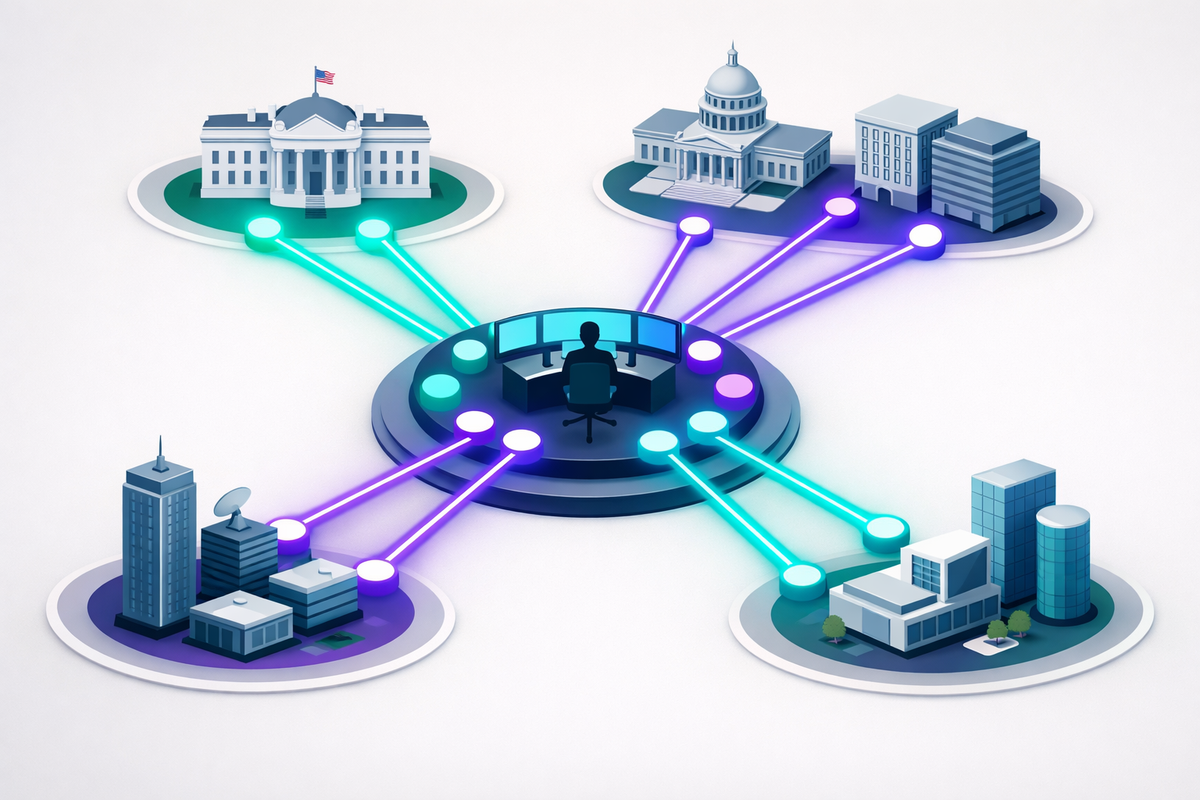
This introduces the role of the "AI Tsar" (policy coordinator), positioned between the White House Office of Science and Technology Policy, regulatory agencies, and private industry. Lacking direct rulemaking powers, this position derives its leverage from making corporate pledges measurable: technical frameworks from NIST (National Institute of Standards and Technology) alongside methodologies like red teaming (adversarial testing), model evaluations, and standardized incident reporting can convert voluntary assurances into verifiable controls.
For enterprise use cases: automated AI auditing and security according to Anthropic and leveraging digital twins for AI compliance and traceability.
Benefits, risks, and reactions generated by the American model
The American approach can accelerate innovation and capital investment, but it escalates uncertainty around safety, transparency, and market concentration. It represents a fundamental trade-off: speed and capital deployment versus public interest protections and legal enforcement, particularly as access to cloud infrastructure and GPUs becomes a strategic bottleneck.
Benefits: Enhanced regulatory flexibility, faster time-to-market, and powerful incentives for infrastructure growth (data centers, domestic silicon, cloud expansion). The participation of major players like Microsoft, Google, and OpenAI makes it easier to establish de facto audit standards across the B2B supply chain.
Risks: Weak enforcement mechanisms, potential "audit shopping," systemic security and privacy externalities, and entrenched market power among cloud hyperscalers. While the FTC (Federal Trade Commission) can intervene ex-post against deceptive practices, it does not replace a comprehensive ex-ante regulatory regime.
Reactions: Investors and venture capital firms generally favor the regulatory speed and market flexibility; conversely, independent researchers and civil society organizations continue to demand mandatory transparency. For a complementary analysis: Big Tech positions on AI regulation and the EU AI Act. Ultimately, the model's credibility relies on whether audits, risk thresholds, and public disclosures can be standardized and independently verified.
FAQ
Is the White House Super Intelligence agreement a federal law?
No: it is a voluntary and "morally binding" agreement between the federal government and private AI companies. It does not establish statutory penalties or create a dedicated federal agency with legal enforcement powers. Its commitments will only gain statutory weight if enacted through subsequent legislation, administrative rules, or formal standards.
Are the audits required under the US pact mandatory to be made public?
Not necessarily. Media reports indicate that the agreement does not mandate the public release of independent evaluation results. In practice, a firm may conduct internal testing and report findings directly to its board without publicly disclosing performance metrics, evaluation thresholds, or safety incidents, thereby limiting external verification.
What is the main difference between the EU AI Act and US voluntary agreements for a B2B vendor?
For a B2B vendor, the EU AI Act imposes binding legal mandates, required technical documentation, and compliance checks tied to risk classification tiers, backed by potential financial penalties. The US agreement outlines best practices and internal audits, but lacks automatic statutory enforcement. Consequently, many global firms choose to build their core governance to meet the stricter EU baseline.
What actually changes when the US government uses "SI" instead of "AI"?
It primarily shifts political framing and administrative focus rather than immediate legal obligations. The executive order issued on September 29, 2026, also calls for proposed legislative draft language within 60 days to formally define "Super Intelligence." Until statutory definitions and quantitative thresholds are enacted into law, the term remains a policy directive.
What is the maximum penalty specified under the EU AI Act for prohibited practices?
The maximum penalty for violating prohibited practice rules reaches up to €35 million or 7% of total global annual turnover, whichever is higher. This statutory ceiling is codified under Article 99 of Regulation (EU) 2024/1689 and applies according to its phased implementation schedule.